
AI + IoT for Work-in-Progress Tracking | Manufacturing Intelligence
Manufacturing performance depends heavily on how efficiently work moves through production. Work-in-progress, often referred to as WIP, represents partially completed goods at various stages of the production lifecycle. Visibility into WIP determines how effectively operations can be managed, optimized, and scaled.
Transforming Work-in-Progress Visibility with AI and IoT-Driven Production Intelligence
Many production environments still rely on fragmented tracking methods such as manual logs, delayed system updates, or isolated machine data. These limitations create blind spots across workflows, making it difficult to understand where delays occur, how resources are utilized, and why throughput fluctuates.
AI and IoT technologies provide a structured way to capture real-time data from across production environments and convert that data into actionable intelligence. By combining physical tracking systems with machine learning models, organizations gain continuous insight into WIP movement, process efficiency, and operational constraints.
This approach transforms WIP from a static reporting metric into a dynamic, continuously monitored system that supports faster decision-making and measurable improvements in production flow.
Challenges in Production Visibility and Workflow Efficiency
Healthcare organizations face persistent challenges in managing specimen workflows efficiently and accurately. These challenges are not isolated incidents but systemic issues that arise from fragmented processes and limited real-time visibility.
Lack of visibility into production stages
A lack of real-time tracking across production stages creates blind spots, making it difficult to monitor progress or predict completion.
Bottlenecks and delays
Unidentified constraints in the workflow stall operations, leading to significant downtime and missed delivery deadlines.
Inefficient workflow coordination
Poor synchronization between departments results in duplicated efforts and inefficient resource allocation throughout the project.
Limited visibility into production stages means that teams cannot easily track the exact status of materials, components, or assemblies. Information gaps lead to uncertainty about whether tasks are ahead of schedule, on track, or delayed. This often results in reactive decision-making rather than proactive control.
Bottlenecks and delays are common in environments where dependencies between processes are not clearly understood. A delay in one stage can ripple across the entire production line, reducing overall throughput. Without real-time insight, identifying the root cause of these bottlenecks becomes time-consuming and imprecise.
Inefficient workflow coordination arises when teams, machines, and systems operate without synchronized data. Production planning, material handling, and labor allocation may not align with actual conditions on the floor. This misalignment leads to idle time, unnecessary movement, and increased cycle times.
Traditional systems typically provide historical reports rather than real-time intelligence. By the time issues are identified, the impact has already affected production targets and delivery timelines.
AI-Driven WIP Tracking and Flow Optimization Solution
AI-powered tracking and flow optimization for WIP enables organizations to move from reactive monitoring to continuous operational intelligence.
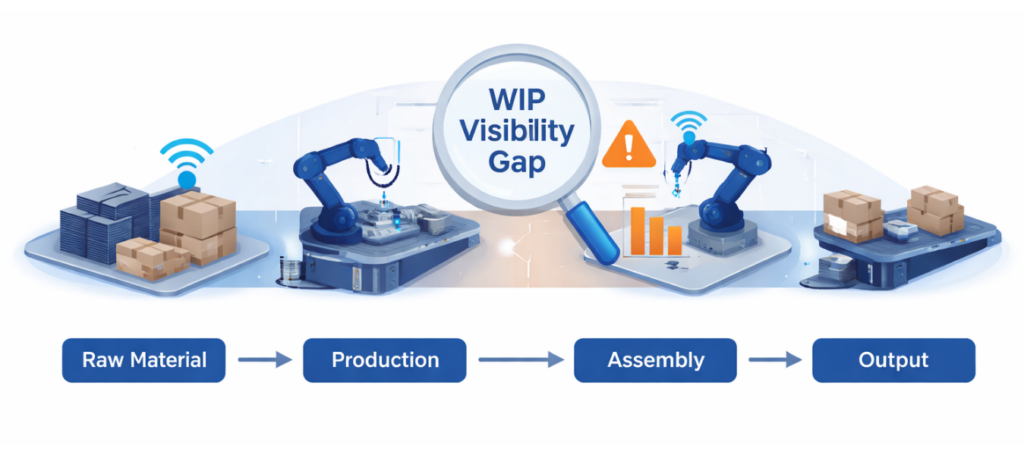
This solution integrates IoT-based data capture with AI-driven analysis to provide real-time visibility into every stage of production. Sensors, RFID tags, machine signals, and connected systems capture data on the movement, status, and condition of work items as they progress through workflows.
The AI layer processes this data to identify patterns, detect anomalies, and predict potential delays. Instead of simply reporting what has already happened, the system highlights emerging issues before they escalate into larger disruptions.
WIP intelligence systems provide a unified view of production activity across lines, facilities, and processes. This unified view allows operations teams to understand how work flows through the system, where constraints exist, and how resources are being utilized.
Flow optimization is achieved through continuous feedback. The system evaluates process efficiency in real time and suggests adjustments to improve throughput. These adjustments may involve redistributing workloads, modifying sequencing, or addressing process imbalances.
The result is a production environment that is continuously monitored, analyzed, and optimized based on real-time data rather than static assumptions.
Key Capabilities
AI + IoT for WIP
AI + IoT for WIP intelligence delivers a set of capabilities designed to provide visibility, control, and optimization across production workflows.
- Real-time WIP tracking
- Bottleneck detection
- Workflow optimization
- Production flow analytics
Real-time WIP tracking enables continuous monitoring of materials and components as they move through production stages. IoT technologies such as RFID, BLE, and machine-integrated sensors provide location and status updates without manual intervention. This ensures that production data remains accurate and up to date.
Bottleneck detection uses AI models to analyze workflow patterns and identify constraints that limit throughput. The system evaluates cycle times, queue lengths, and resource utilization to determine where delays are occurring. It can also highlight recurring issues that may not be immediately visible through manual observation.
Workflow optimization focuses on improving how work progresses through the system. AI models simulate different scenarios and recommend adjustments to reduce delays and improve efficiency. These recommendations may include rebalancing workloads, adjusting process sequences, or reallocating resources.
Production flow analytics provides deeper insight into how production systems operate over time. Analytics dashboards present data on throughput, cycle time, work distribution, and process variability. This information helps teams understand trends, measure performance, and identify opportunities for improvement.
Together, these capabilities create a comprehensive system for managing WIP as an active component of operational strategy rather than a passive metric.
How the System Works
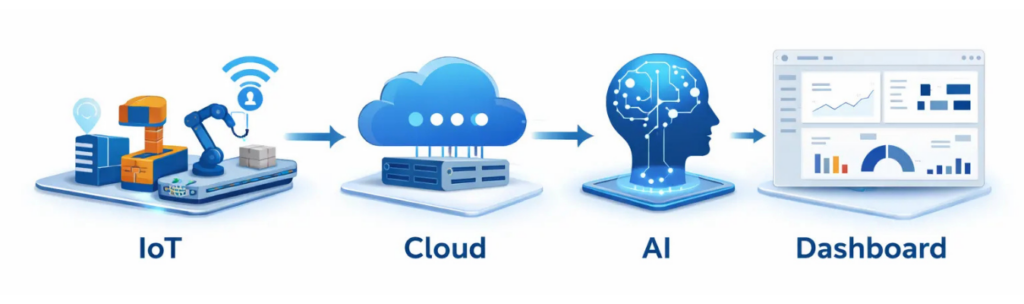
WIP intelligence systems operate through a structured process that connects physical data capture with advanced analytics.
Data collection begins with IoT devices deployed across the production environment. These devices capture information about the movement and status of work items, including location, processing stage, and time spent at each step.
Data integration brings together inputs from multiple sources such as machines, enterprise systems, and tracking technologies. This creates a unified data layer that represents the current state of production.
AI models analyze this data to identify patterns, detect anomalies, and predict future states. Machine learning algorithms continuously refine their accuracy as more data becomes available.
Insights are delivered through dashboards, alerts, and automated actions. Operations teams can view real-time status, receive notifications about potential issues, and take immediate action to address them.
This closed-loop system ensures that data is not only collected but also used to drive continuous improvement in production performance.
Applications Across Manufacturing Environments
WIP intelligence can be applied across a wide range of manufacturing settings, each with its own operational requirements and challenges.
Discrete manufacturing environments benefit from precise tracking of individual components and assemblies. Real-time visibility helps ensure that production schedules are met and that dependencies between processes are managed effectively.
Process manufacturing environments use WIP intelligence to monitor continuous flows and identify variations that may affect quality or efficiency. Real-time data helps maintain consistent production conditions and reduce variability.
High-mix, low-volume production environments gain improved coordination across complex workflows. WIP intelligence supports better planning and execution by providing accurate information about the status of each work item.
Multi-facility operations can use WIP intelligence to standardize processes and compare performance across locations. This enables organizations to identify best practices and implement them consistently.
Integration with Existing Systems
WIP intelligence solutions are designed to work alongside existing enterprise and operational systems.
Integration with manufacturing execution systems provides a detailed view of production processes and schedules. Data from MES platform can be combined with IoT inputs to create a more complete picture of WIP.
Enterprise resource planning systems contribute data related to orders, inventory, and planning. Integrating ERP data with WIP intelligence enables better alignment between production and business objectives.
Machine data integration allows the system to capture real-time information about equipment performance and processing times. This enhances the accuracy of workflow analysis and bottleneck detection.
The ability to integrate across systems ensures that WIP intelligence becomes part of a broader operational ecosystem rather than a standalone tool.
Business Outcomes
Organizations that implement AI + IoT for WIP intelligence experience measurable improvements in production performance and operational efficiency.
- Increased throughput
- Reduced cycle time
- Improved operational efficiency
Increased throughput results from the ability to identify and eliminate bottlenecks. By ensuring that work flows smoothly through each stage, production capacity can be utilized more effectively.
Reduced cycle time is achieved by minimizing delays and optimizing process sequences. Real-time insights allow teams to address issues quickly and maintain consistent production flow.
Improved operational efficiency comes from better coordination of resources, including labor, equipment, and materials. Accurate data enables more informed decision-making and reduces waste across processes.
Additional benefits often include improved on-time delivery, better resource utilization, and enhanced visibility for management teams.
Strategic Impact
WIP intelligence does more than improve day-to-day operations. It also supports long-term strategic goals.
Organizations gain a deeper understanding of how their production systems operate. This understanding enables more effective planning, investment decisions, and process improvements.
Data-driven insights support continuous improvement initiatives by providing objective measurements of performance. Teams can test changes, measure results, and refine processes based on real data.
Scalability improves as systems become more predictable and easier to manage. WIP intelligence provides the foundation for expanding production capacity without introducing inefficiencies.
Digital transformation efforts are strengthened by integrating physical operations with advanced analytics. WIP intelligence becomes a key component of a broader strategy to modernize manufacturing systems.
U.S. and Canadian Standards and Regulations
- ISO 9001 Quality Management Systems
- ISO 22400 Key Performance Indicators for Manufacturing Operations
- ISO 55000 Asset Management
- ISO/IEC 30141 IoT Reference Architecture
- ISO/IEC 27001 Information Security Management
- ANSI/ISA-95 Enterprise-Control System Integration
- ANSI/ISA-88 Batch Control
- NIST Cybersecurity Framework
- NIST SP 800-53 Security and Privacy Controls
- NIST SP 800-82 Industrial Control Systems Security
- OSHA 29 CFR 1910 Occupational Safety and Health Standards
- NFPA 70 National Electrical Code
- NFPA 79 Electrical Standard for Industrial Machinery
- FDA 21 CFR Part 11 Electronic Records and Signatures
- FDA 21 CFR Part 820 Quality System Regulation
- EPA Clean Air Act Compliance Standards
- EPA Resource Conservation and Recovery Act
- CSA C22.1 Canadian Electrical Code
- CSA Z432 Safeguarding of Machinery
- CSA Z1000 Occupational Health and Safety Management
- ISED Canada Radio Standards Specifications
- PIPEDA Personal Information Protection and Electronic Documents Act
Top Players in the Domain
- Automotive manufacturing companies
- Aerospace and defense manufacturers
- Electronics and semiconductor manufacturers
- Industrial equipment manufacturers
- Pharmaceutical manufacturing companies
- Medical device manufacturers
- Food and beverage processing companies
- Chemical and process manufacturing firms
- Logistics and supply chain operators
- Warehousing and distribution enterprises
- Energy and utilities equipment manufacturers
- Construction materials manufacturers
Case Studies
United States Case Studies
Chicago, Illinois
Problem
A multi-line discrete manufacturing facility faced inconsistent visibility into WIP across assembly stages, leading to frequent delays and unbalanced workloads.
Solution
We deployed RFID-based asset tracking integrated with IoT sensors across workstations. Our system captured real-time movement and processing status, while AI models analyzed cycle times and queue lengths.
Result
Throughput increased by 18 percent and cycle time reduced by 22 percent within six months. A key lesson showed that initial data calibration required careful tuning to avoid false bottleneck signals.
Houston, Texas
Problem
A process manufacturing plant struggled with undetected delays in continuous production flows, impacting output consistency.
Solution
Our team implemented BLE-based tracking and machine data integration to monitor material progression and processing conditions in real time.
Result
Production variability decreased by 15 percent and downtime events were reduced by 20 percent. A trade-off involved increased sensor maintenance requirements in high-temperature environments.
Detroit, Michigan
Problem
An automotive production facility experienced bottlenecks due to lack of synchronization between robotic systems and manual assembly stages.
Solution
We deployed an integrated WIP intelligence system combining RFID tracking with AI-driven workflow optimization.
Result
Cycle time improved by 19 percent and idle labor time decreased by 25 percent. The lesson highlighted the importance of aligning human workflows with automated processes.
San Jose, California
Problem
A high-mix electronics manufacturer faced difficulty tracking individual components across complex workflows.
Solution
Our solution used RFID tagging for component-level tracking and analytics dashboards for production flow visibility.
Result
Error rates in assembly dropped by 14 percent and tracking accuracy reached 98 percent. A key lesson involved managing tag placement to avoid signal interference.
Atlanta, Georgia
Problem
A distribution-linked manufacturing operation lacked coordination between production and warehouse workflows.
Solution
We implemented an IoT-based asset and people tracking system to synchronize material movement and labor allocation.
Result
Material handling delays reduced by 21 percent and order fulfillment improved by 17 percent. Trade-offs included initial workforce training requirements.
Seattle, Washington
Problem
An aerospace manufacturing site encountered delays due to limited traceability of components across long production cycles.
Solution
Our team deployed RFID-enabled tracking with AI-based anomaly detection for identifying process delays.
Result
Lead time reduced by 16 percent and traceability compliance improved significantly. A lesson emphasized the need for phased deployment in complex environments.
Phoenix, Arizona
Problem
A semiconductor facility struggled with identifying process inefficiencies across multiple fabrication stages.
Solution
We integrated IoT sensors with machine data and applied AI analytics to detect workflow constraints.
Result
Process efficiency improved by 13 percent and rework rates decreased by 11 percent. The trade-off involved high initial integration effort.
Minneapolis, Minnesota
Problem
A medical device manufacturer required precise tracking of WIP for regulatory compliance and quality assurance.
Solution
Our system combined RFID tracking with access control systems to monitor movement and ensure controlled workflows.
Result
Compliance reporting accuracy improved by 20 percent and audit preparation time reduced by 30 percent. A lesson involved balancing security with operational speed.
Denver, Colorado
Problem
A fabrication facility experienced inconsistent throughput due to uneven workload distribution.
Solution
We deployed AI-driven workflow optimization supported by IoT-based tracking systems.
Result
Throughput increased by 15 percent and process imbalance reduced by 18 percent. Trade-offs included iterative tuning of AI models.
Boston, Massachusetts
Problem
A pharmaceutical manufacturing site faced delays in batch processing visibility.
Solution
Our team implemented IoT-enabled tracking and integrated data with enterprise systems for real-time monitoring.
Result
Batch cycle times reduced by 12 percent and visibility improved across all stages. A lesson emphasized strict validation requirements.
Dallas, Texas
Problem
A large-scale manufacturing facility lacked coordination across multiple production lines.
Solution
We introduced a unified WIP intelligence platform integrating BLE tracking and production analytics.
Result
Operational efficiency improved by 17 percent and inter-line delays decreased by 19 percent. Trade-offs included system scalability considerations.
Los Angeles, California
Problem
A consumer goods manufacturer struggled with tracking WIP across geographically distributed facilities.
Solution
Our solution used IoT-based tracking systems with centralized analytics dashboards.
Result
Cross-facility visibility improved by 23 percent and delivery delays reduced by 14 percent. A lesson involved network infrastructure upgrades.
Canadian Case Studies
Toronto, Ontario
Problem
A manufacturing facility experienced limited visibility into WIP movement across multiple production stages.
Solution
We deployed RFID-based tracking integrated with AI analytics for bottleneck detection.
Result
Cycle time reduced by 18 percent and workflow transparency improved significantly. A lesson involved optimizing tag density.
Vancouver, British Columbia
Problem
A process manufacturing plant faced variability in production flow due to lack of real-time monitoring.
Solution
Our team implemented IoT sensors and machine data integration for continuous flow analysis.
Result
Production consistency improved by 16 percent and downtime reduced by 12 percent. Trade-offs included environmental sensor calibration.
Montreal, Quebec
Problem
An electronics manufacturer required better coordination across high-mix production lines.
Solution
We introduced BLE-based tracking and AI-driven workflow optimization tools.
Result
Throughput increased by 14 percent and scheduling efficiency improved by 20 percent. A lesson emphasized data integration complexity.
Calgary, Alberta
Problem
A heavy equipment manufacturing site struggled with tracking large components across expansive facilities.
Solution
Our system deployed RFID and asset tracking solutions with location analytics.
Result
Tracking accuracy improved to 97 percent and search time reduced by 28 percent. Trade-offs included infrastructure deployment costs.
Ottawa, Ontario
Problem
A technology manufacturing facility faced delays due to inefficient coordination between production and testing stages.
Solution
We implemented an integrated WIP intelligence system combining IoT tracking and analytics dashboards.
Result
Cycle time reduced by 15 percent and process synchronization improved by 18 percent. A lesson involved aligning testing workflows with production timelines.