
Real-Time People
Tracking &
Safety
Intelligence
Tracking & Safety
Intelligence
Transform workforce visibility into a structured intelligence layer. Combine IoT tracking with AI analytics for proactive safety, automated compliance, and coordinated emergency response.
Introduction
Real-Time People Tracking & Safety Intelligence
Workforce safety and operational awareness depend on accurate, real-time visibility into where people are, how they move, and how they interact with physical environments. Many organizations still rely on manual supervision, fragmented systems, or delayed reporting, which creates blind spots in safety monitoring and slows response during critical situations.
Aperture AIoT enables organizations to transform workforce visibility into a structured intelligence layer. By combining IoT-based tracking technologies with AI-driven analytics, the platform provides continuous awareness of personnel location, behavior, and risk exposure across facilities, job sites, and operational zones.
This system goes beyond simple tracking. It creates a dynamic model of workforce activity, enabling proactive safety management, automated compliance monitoring, and coordinated emergency response. The result is a measurable improvement in worker protection, operational control, and regulatory alignment.
The approach aligns with the broader Aperture AIoT vision of converting real-world signals into intelligent systems and scalable solutions.
The Challenge
The Problem
Organizations across industrial, construction, logistics, healthcare, and energy sectors face persistent challenges in managing workforce safety and visibility. These challenges are not limited to tracking individuals but extend to understanding behavior, enforcing safety policies, and responding effectively to incidents.
Limited visibility into worker locations across large or complex environments
Inability to monitor movement in real time across zones, floors, or facilities
Safety risks in hazardous areas such as confined spaces, high-temperature zones, or restricted access locations
Delayed awareness of incidents such as falls, injuries, or unauthorized entry
Manual compliance tracking that relies on audits rather than continuous monitoring
Lack of coordination during emergencies due to missing or outdated personnel data
Difficulty ensuring that workers follow safety protocols such as wearing protective equipment or staying within authorized zones
These limitations increase the likelihood of accidents, reduce operational efficiency, and expose organizations to regulatory penalties and liability risks.
Workforce safety systems must evolve from reactive reporting tools into proactive intelligence systems that continuously analyze and respond to real-world conditions.
Workforce Analytics
The Solution
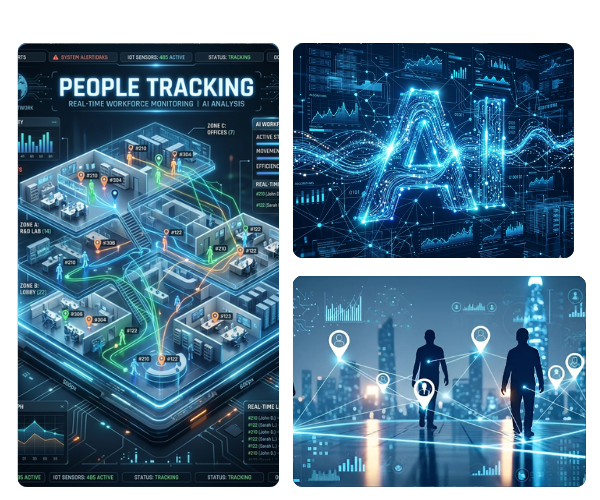
Aperture AIoT delivers a real-time workforce intelligence system powered by IoT and AI. It integrates wearable devices, badges, mobile sensors, and infrastructure-based tracking technologies to capture continuous location and movement data.
This data is processed through an AI layer that identifies patterns, detects anomalies, and generates actionable insights. The system does not simply record where workers are. It understands how they interact with environments, how risks develop, and when intervention is required.
This architecture enables organizations to shift from reactive safety management to proactive and predictive safety intelligence.
Data Capture
RFID, BLE, UWB, GPS, and sensor-enabled wearables capture continuous location and movement data.
Real-Time Integration
Data from multiple sources is unified into a centralized system — a single source of truth for workforce activity.
AI Analysis
Machine learning models analyze movement patterns, detect anomalies, and identify potential risks in real time.
Action & Response
Dashboards, alerts, and automated triggers deliver insights and initiate predefined safety responses.
Architecture
How the System Works
Data Capture Layer
Data Integration Layer
AI Intelligence Layer
Action & Response Layer
Features
Key Capabilities
Real-Time Location Tracking
- Indoor and outdoor positioning using multiple technologies
- Zone-based tracking for defined operational areas
- Historical movement data for analysis and reporting
- Visualization through dashboards and digital maps
Safety Alerts and Geofencing
The system enforces safety policies by defining virtual boundaries and triggering alerts when violations occur.
- Entry and exit monitoring for restricted zones
- Alerts for unauthorized access or unsafe proximity
- Real-time notifications for supervisors and control rooms
- Automated escalation based on severity levels
Behavior Analysis
AI models analyze how workers move and interact with their environment to identify patterns and detect risks.
- Identification of unsafe behavior patterns
- Detection of unusual movement or inactivity
- Analysis of crowd density and congestion
- Continuous learning from operational data
Emergency Response Coordination
During emergencies, accurate and immediate information is critical. The system enables rapid and coordinated response.
- Real-time visibility of all personnel locations
- Identification of individuals in affected zones
- Automated alerts and evacuation support
- Integration with emergency systems and protocols
Compliance Monitoring
Regulatory compliance requires continuous tracking of workforce activities and adherence to safety protocols.
- Automated tracking of safety rule compliance
- Digital audit trails for inspections and reporting
- Monitoring of time spent in hazardous areas
- Integration with compliance and reporting systems
Integration with Access Control
People tracking systems can work alongside access control systems to enforce security and safety policies.
- Verification of identity and authorization
- Correlation of access events with location data
- Detection of unauthorized movement after access
- Enhanced visibility across security and safety systems
Technology Stack
The effectiveness of a people tracking and safety system depends on the combination of hardware, connectivity, and analytics technologies.
- RFID for identification and checkpoint tracking
- BLE for proximity-based tracking and indoor positioning
- UWB for high-precision location tracking in critical environments
- GPS for outdoor tracking across large areas
- Wearable devices for continuous monitoring and worker interaction
- Edge gateways for real-time data processing
- Cloud infrastructure for data aggregation and analytics
- AI models for pattern recognition and predictive insights
The system architecture is modular, allowing organizations to deploy technologies based on specific use cases, accuracy requirements, and operational environments.
The Deployment
Industry Applications
Construction
• Tracking workers across dynamic job sites
• Preventing unauthorized access to hazardous zones
• Supporting emergency evacuation and rescue
Logistics and Warehousing
• Managing workforce movement across large facilities
• Improving coordination between teams and operations
• Enhancing safety in high-traffic areas
Healthcare
• Tracking staff within hospitals and facilities
• Ensuring rapid response during emergencies
• Monitoring compliance with safety protocols
Energy and Utilities
• Monitoring workers in remote or hazardous locations
• Ensuring compliance with safety regulations
• Supporting incident response in critical environments
Manufacturing
• Monitoring worker presence on production floors
• Ensuring compliance with safety zones and procedures
• Reducing incidents in high-risk areas
Business Outcomes
Organizations that implement AI-driven people tracking and safety systems achieve measurable improvements across safety, compliance, and operational efficiency.
- Improved worker safety through proactive risk detection
- Reduction in workplace incidents and accidents
- Faster emergency response with real-time visibility
- Enhanced compliance with safety regulations and standards
- Better workforce coordination and productivity
- Reduced liability and insurance costs
- Increased operational awareness across facilities
These outcomes are not limited to safety improvements. They also contribute to overall operational efficiency and long-term organizational resilience.
Data and Intelligence Advantage
A key differentiator of the Aperture AIoT approach is the ability to transform workforce data into a continuous intelligence stream.
Instead of isolated data points, the system builds a comprehensive understanding of workforce behavior over time. This enables organizations to:
- Identify recurring safety risks and operational inefficiencies
- Optimize workforce allocation and movement
- Improve training and safety program effectiveness
- Predict potential incidents before they occur
This data-driven approach creates a feedback loop where every interaction improves the system’s accuracy and value.
Deployment Considerations
Successful deployment requires careful planning and alignment with operational needs.
- Selection of appropriate tracking technologies based on environment
- Integration with existing systems such as access control and HR platform
- Definition of safety policies and geofencing rules
- Training for workers and supervisors
- Continuous monitoring and optimization of system performance
The modular design of the platform allows organizations to start with specific use cases and expand over time.
Why It Matters Now
Workforce safety expectations are increasing due to stricter regulations, higher operational complexity, and growing awareness of workplace risks. At the same time, advances in IoT and AI make it possible to achieve levels of visibility and control that were not previously feasible.
Organizations that adopt intelligent safety systems gain a strategic advantage. They not only reduce risk but also build a foundation for broader operational intelligence across assets, processes, and environments.
U.S. and Canadian Standards and Regulations
- OSHA 29 CFR 1910 Occupational Safety and Health Standards
- OSHA 29 CFR 1926 Construction Safety Standards
- ANSI/ASSE Z117.1 Safety Requirements for Confined Spaces
- ANSI/ISEA 107 High-Visibility Safety Apparel
- NFPA 70 National Electrical Code (NEC)
- NFPA 72 National Fire Alarm and Signaling Code
- NFPA 101 Life Safety Code
- NIOSH Occupational Safety Guidelines
- ISO 45001 Occupational Health and Safety Management Systems
- ISO 27001 Information Security Management
- Transport Canada Safety Regulations (for logistics and mobility environments)
- ISO 22301 Business Continuity Management
- FCC Part 15 Regulations for Wireless Devices
- NIST Cybersecurity Framework
- HIPAA (for healthcare workforce tracking data in the U.S.)
- PIPEDA Personal Information Protection and Electronic Documents Act (Canada)
- Canadian Centre for Occupational Health and Safety (CCOHS) Regulations
- CSA Z1000 Occupational Health and Safety Management
- CSA Z462 Workplace Electrical Safety
- Innovation, Science and Economic Development Canada (ISED) Radio Standards
Top Players in the Domain
- Manufacturing enterprises with multi-site production facilities
- Construction firms managing large and dynamic job sites
- Logistics and warehousing operators with high workforce density
- Healthcare systems including hospitals and large medical campuses
- Energy and utilities companies operating in hazardous environments
- Mining and natural resources organizations
- Oil and gas operators with remote and high-risk worksites
- Transportation and infrastructure management authorities
- Smart city operators and municipal safety departments
- Aviation and airport operations teams
- Defense and secure facility operators
- Facility management companies handling large campuses
Case Studies
U.S. Case Studies
Manufacturing Safety Monitoring in Detroit, Michigan
- Problem: Limited visibility into worker movement across production floors led to delayed detection of unsafe zone entry and increased safety incidents.
- Solution: We implemented a BLE-based people tracking system integrated with RFID checkpoints to monitor worker locations in real time. Geofencing rules were configured for hazardous machinery zones, and AI models analyzed movement patterns to detect anomalies.
- Result: Incident response time improved by 35 percent, and unauthorized zone entries decreased by 28 percent.
- Lesson: A key lesson involved balancing tracking accuracy with battery life in wearable devices.
Construction Site Worker Tracking in Houston, Texas
- Problem: Dynamic site conditions created blind spots in workforce visibility, leading to delayed emergency response during incidents.
- Solution: Our system deployed GPS and UWB-enabled wearables to track workers across evolving site layouts. Real-time dashboards provided supervisors with live workforce distribution.
- Result: Emergency evacuation time reduced by 40 percent.
- Lesson: Trade-off observed in maintaining infrastructure coverage during rapid site changes.
Warehouse Workforce Coordination in Chicago, Illinois
- Problem: High worker density and equipment movement increased collision risks and reduced operational efficiency.
- Solution: We deployed RFID and BLE tracking integrated with proximity alerts to monitor worker interactions and congestion zones.
- Result: Workplace incidents reduced by 22 percent, and operational coordination improved by 18 percent.
- Lesson: Lesson learned involved optimizing alert thresholds to avoid alert fatigue.
Hospital Staff Tracking in Boston, Massachusetts
- Problem: Delayed response to emergencies due to lack of real-time staff location data.
- Solution: Our system used BLE badges to track medical staff and integrated with emergency response systems for rapid coordination.
- Result: Response time to critical incidents improved by 30 percent.
- Lesson: Trade-off included ensuring privacy compliance with tracking policies.
Energy Facility Safety in Dallas, Texas
- Problem: Workers in hazardous zones lacked continuous monitoring, increasing exposure risks.
- Solution: We deployed UWB-based tracking combined with environmental sensors to monitor worker presence in high-risk areas.
- Result: Exposure incidents reduced by 25 percent.
- Lesson: Lesson involved calibrating sensor thresholds for environmental variability.
Airport Workforce Monitoring in Atlanta, Georgia
- Problem: Complex operations required precise tracking of ground staff across restricted zones.
- Solution: Our access control and people tracking systems were integrated to correlate entry permissions with movement data.
- Result: Unauthorized movement reduced by 32 percent.
- Lesson: Trade-off included integration complexity with legacy systems.
Mining Workforce Safety in Denver, Colorado
- Problem: Limited visibility in underground environments led to delayed incident detection.
- Solution: We implemented RFID-based tracking with gateway infrastructure to monitor worker locations in real time.
- Result: Incident detection time improved by 38 percent.
- Lesson: Lesson involved infrastructure placement challenges in underground conditions.
Logistics Hub Safety in Los Angeles, California
- Problem: High traffic zones created safety risks for workers and equipment operators.
- Solution: Our system deployed BLE-based proximity detection and AI-driven behavior analysis to monitor movement patterns.
- Result: Collision incidents reduced by 20 percent.
- Lesson: Trade-off included tuning sensitivity for diverse operational conditions.
Utility Field Workforce Tracking in Phoenix, Arizona
- Problem: Remote operations lacked real-time workforce visibility and coordination.
- Solution: We deployed GPS-enabled tracking integrated with centralized dashboards for remote monitoring.
- Result: Operational response efficiency improved by 27 percent.
- Lesson: Lesson involved connectivity challenges in remote areas.
Industrial Plant Compliance Monitoring in Cleveland, Ohio
- Problem: Manual compliance tracking resulted in incomplete audit trails.
- Solution: Our system automated compliance monitoring using RFID and AI analytics to track worker presence in regulated zones.
- Result: Compliance reporting accuracy improved by 45 percent.
- Lesson: Trade-off included initial setup complexity.
Smart Campus Workforce Safety in San Jose, California
- Problem: Large campus operations required continuous monitoring of staff movement and safety compliance.
- Solution: We deployed an integrated IoT system combining BLE tracking and access control for real-time visibility.
- Result: Safety incidents reduced by 26 percent.
- Lesson: Lesson involved scaling infrastructure across distributed buildings.
Oil and Gas Site Monitoring in Oklahoma City, Oklahoma
- Problem: Hazardous environments required precise tracking of personnel for safety compliance.
- Solution: Our system used UWB and wearable sensors to monitor worker locations and exposure durations.
- Result: Safety compliance improved by 33 percent.
- Lesson: Trade-off included managing device durability in harsh environments.
Canadian Case Studies
Manufacturing Safety Monitoring in Detroit, Michigan
- Problem: Limited real-time visibility into worker movement impacted safety monitoring.
- Solution: We deployed BLE-based tracking integrated with AI analytics for behavior monitoring.
- Result: Incident rates reduced by 24 percent.
Lesson: Lesson involved aligning tracking policies with privacy regulations
Construction Site Tracking in Vancouver, British Columbia
- Problem: Dynamic job site conditions created gaps in workforce tracking.
- Solution: Our system implemented GPS and RFID tracking to monitor worker locations and enforce geofencing rules.
- Result: Emergency response time improved by 36 percent.
- Lesson: Trade-off included maintaining device accuracy in dense urban areas.
Healthcare Staff Coordination in Montreal, Quebec
- Problem: Delayed coordination during emergencies due to lack of staff location data.
- Solution: We deployed BLE-based badges integrated with hospital systems for real-time tracking.
- Result: Response efficiency improved by 29 percent.
- Lesson: Lesson involved ensuring data security compliance.
Energy Sector Workforce Monitoring in Calgary, Alberta
- Problem: Workers in hazardous environments lacked continuous monitoring.
- Solution: Our system used UWB tracking and environmental sensors for real-time safety monitoring.
- Result: Exposure incidents reduced by 27 percent.
- Lesson: Trade-off included infrastructure deployment challenges in remote areas.
Logistics Facility Safety in Winnipeg, Manitoba
- Problem: High worker density increased safety risks and reduced operational efficiency.
- Solution: We deployed RFID and BLE-based tracking with proximity alerts and analytics.
- Result: Operational efficiency improved by 19 percent, and incidents reduced by 21 percent.
- Lesson: Lesson involved optimizing alert configurations.
Conclusion
People tracking and safety systems are evolving from basic monitoring tools into intelligent platform that actively protect workers and optimize operations. Aperture AIoT enables this transformation by combining real-time tracking with advanced analytics and automation.
By turning workforce data into actionable intelligence, organizations can create safer environments, respond faster to incidents, and ensure continuous compliance across operations.