
AI + IoT for Specimen Tracking | Aperture AIoT
Accurate specimen tracking forms the foundation of reliable diagnostics, clinical decision-making, and patient safety. Every sample collected, transported, processed, and stored represents a critical data point in the healthcare workflow. Even a minor breakdown in traceability can lead to delayed diagnoses, incorrect treatments, or regulatory violations.
Transforming Specimen Tracking with AI + IoT
Healthcare providers, diagnostic laboratories, and research institutions continue to manage growing volumes of specimens across increasingly complex workflows. Manual processes, disconnected systems, and limited visibility introduce risks that are difficult to control at scale.
AI and IoT enable a new model for specimen tracking. Sensors, RFID, barcodes, and connected systems capture real-time data at every step. Artificial intelligence analyzes this data to detect anomalies, enforce chain-of-custody, and ensure compliance with operational and regulatory standards.
Aperture AIoT delivers a unified system that tracks specimens across their entire lifecycle with precision and intelligence. Each specimen becomes a traceable, verifiable entity within a broader healthcare intelligence platform.
Challenges in Specimen Tracking
Healthcare organizations face persistent challenges in managing specimen workflows efficiently and accurately. These challenges are not isolated incidents but systemic issues that arise from fragmented processes and limited real-time visibility.

Mislabeling or incorrect identification of specimens
Inaccurate tagging and data entry create significant diagnostic risks, leading to redundant testing and wasted resources.

Loss or misplacement during transport or handling
Logistical gaps during transport frequently result in displaced samples, stalling workflows and delaying critical results.
Lack of real-time visibility across departments and facilities
Without live tracking, teams cannot locate specimens, making it impossible to optimize workflows or prevent transit issues.
Manual logging and data entry errors
Relying on manual entry consumes valuable administrative time and introduces human errors that compromise record quality.
Delays in specimen processing and reporting
Slow turnaround times for processing and reporting hinder clinical decisions and directly impact the speed of patient care.

Incomplete or inconsistent chain-of-custody records
Gaps in transfer records make it difficult to verify specimen integrity, leading to significant legal and clinical risks.

Difficulty meeting regulatory and accreditation requirements
Tracking gaps make it difficult to prove compliance, leaving the organization vulnerable to heavy penalties and failed audits.

Limited ability to detect anomalies or process deviations
Limited oversight prevents the early detection of process deviations, allowing small errors to escalate into systemic failures.
Mislabeling remains one of the most critical risks. A mislabeled specimen can lead to incorrect test results, potentially affecting diagnosis and treatment decisions. Manual labeling processes increase the likelihood of human error, especially under high workload conditions.
Specimen loss or misplacement introduces additional complications. Samples may move across multiple locations such as collection points, transport systems, laboratories, and storage facilities. Without continuous tracking, identifying the last known location becomes difficult, leading to delays and repeat collections.
Lack of real-time tracking prevents healthcare teams from responding proactively. Many systems rely on batch updates or manual logs, which provide outdated or incomplete information. This gap reduces operational efficiency and increases turnaround times.
Compliance risks continue to grow as regulatory frameworks demand stricter traceability and documentation. Healthcare providers must maintain accurate records for audits, quality assurance, and patient safety standards. Manual processes make it difficult to maintain consistent compliance across large-scale operations.
End-to-End Specimen Intelligence with AI and IoT
- Aperture AIoT introduces an end-to-end specimen intelligence system powered by AI and IoT technologies. This system transforms traditional tracking into a continuous, data-driven process.
- Each specimen is digitally identified and tracked from the point of collection through transportation, processing, storage, and final reporting. IoT devices capture location, time, and environmental data in real time, while AI models analyze this data to ensure accuracy and consistency.
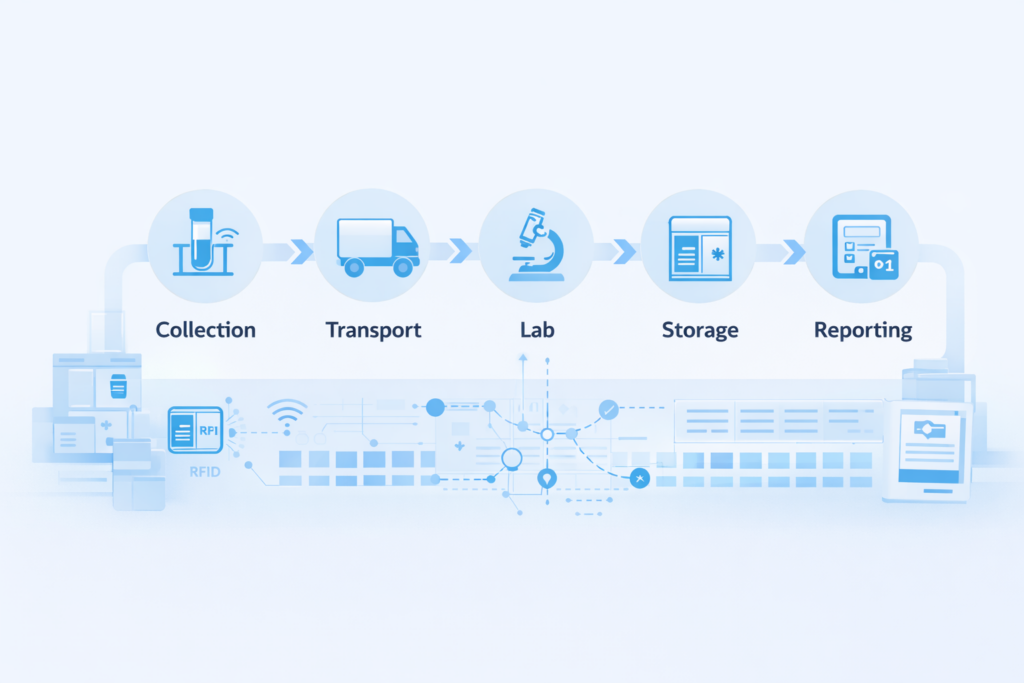
AI and IoT enable a new model for specimen tracking. Sensors, RFID, barcodes, and connected systems capture real-time data at every step. Artificial intelligence analyzes this data to detect anomalies, enforce chain-of-custody, and ensure compliance with operational and regulatory standards.
Aperture AIoT delivers a unified system that tracks specimens across their entire lifecycle with precision and intelligence. Each specimen becomes a traceable, verifiable entity within a broader healthcare intelligence platform.
Business Outcomes
Improved Patient Safety
Accurate tracking reduces the risk of misidentification and errors.
- Ensure correct specimen-to-patient matching
- Reduce diagnostic errors
- Support reliable clinical decision-making
Patient safety improves when data integrity is maintained at every step.
Reduced Errors and Rework
Automation and real-time tracking significantly reduce manual errors.
- Minimize labeling mistakes
- Prevent specimen loss
- Reduce need for repeat collections
Lower error rates translate into better efficiency and cost savings.
Regulatory Compliance
Automated documentation and traceability support compliance requirements.
- Maintain complete chain-of-custody records
- Generate audit-ready reports
- Align with healthcare regulations and standards
Compliance becomes a built-in feature rather than a manual process.
Operational Efficiency
Real-time visibility and AI insights streamline workflows.
- Reduce turnaround times
- Improve coordination between teams
- Optimize resource utilization
Efficiency gains help laboratories handle higher volumes without compromising quality.
Data-Driven Decision Making
Continuous data collection enables better operational insights.
- Identify trends and performance gaps
- Improve process design
- Support long-term planning
Organizations gain the ability to evolve based on real data rather than assumptions.
Scalability Across Healthcare Networks
The system adapts to growing volumes and expanding operations.
- Support multi-location healthcare systems
- Standardize processes across facilities
- Maintain consistency at scale
Scalability ensures that the system remains effective as operations grow.
Applications Across Healthcare Settings
Specimen tracking systems apply across a wide range of healthcare environments.
- Hospitals and clinical laboratories
- Diagnostic centers
- Blood banks and biobanks
- Research and clinical trial facilities
- Pathology laboratories
- Pharmaceutical testing environments
Each of these settings benefits from improved traceability, reduced errors, and enhanced operational control.
Key Capabilities
Real-Time Specimen Tracking
Real-time tracking provides continuous visibility into the location and status of each specimen.
- Track specimens across collection, transport, processing, and storage
- Use RFID, barcode, or BLE technologies for identification and tracking
- Monitor movement across departments and facilities
- Reduce dependency on manual updates
This capability ensures that healthcare teams always know where a specimen is and what stage it is in.
Chain-of-Custody Monitoring
Maintaining a verified chain-of-custody is critical for both clinical and regulatory requirements.
- Record every interaction with the specimen
- Capture timestamps, locations, and responsible personnel
- Ensure accountability across the entire workflow
- Generate audit-ready records automatically
This capability reduces compliance risks and supports quality assurance processes.
AI Anomaly Detection
AI models continuously analyze specimen data to identify irregularities.
- Detect delays in transport or processing
- Identify incorrect routing or handling errors
- Flag missing or inconsistent data entries
- Generate alerts for immediate action
Anomaly detection shifts specimen management from reactive to proactive operations.
Integration with Lab Systems
Integration ensures that specimen tracking is part of a unified healthcare ecosystem.
- Connect with laboratory information systems
- Integrate with hospital and clinical systems
- Synchronize data across platform
- Enable end-to-end workflow visibility
This capability eliminates data silos and improves coordination between teams.
Environmental Monitoring for Specimens
Sensitive specimens often require controlled conditions during transport and storage.
- Monitor temperature, humidity, and other environmental factors
- Ensure compliance with handling requirements
- Detect deviations that may affect specimen integrity
- Maintain quality standards across the lifecycle
Environmental monitoring adds an additional layer of assurance for specimen reliability.
Automated Workflow Intelligence
AI enables continuous optimization of specimen workflows.
- Analyze processing times and identify bottlenecks
- Optimize routing and handling procedures
- Improve turnaround times
- Support data-driven operational decisions
Workflow intelligence improves efficiency without increasing manual workload.
Applicable U.S. and Canadian Standards and Regulations
- HIPAA (Health Insurance Portability and Accountability Act)
- CLIA (Clinical Laboratory Improvement Amendments)
- FDA 21 CFR Part 11
- FDA 21 CFR Part 820
- CAP (College of American Pathologists) Accreditation Standards
- ISO 15189 Medical Laboratories
- ISO 17025 Testing and Calibration Laboratories
- HL7 Standards
- ASTM E1381 and ASTM E1394
- CDC Laboratory Biosafety Guidelines
- OSHA Bloodborne Pathogens Standard
- AABB Standards for Blood Banks and Transfusion Services
- Health Canada Medical Devices Regulations (SOR/98-282)
- PIPEDA (Personal Information Protection and Electronic Documents Act)
- PHIPA (Personal Health Information Protection Act, Ontario)
- CSA Z316.7 Health Care Facility Design
- ISO 13485 Medical Devices Quality Management Systems
- GxP (GLP, GMP, GCP) Guidelines
- Transport Canada TDG (Transportation of Dangerous Goods) Regulations
Top Customers (Players) in the Domain
- Mayo Clinic
- Cleveland Clinic
- Kaiser Permanente
- Quest Diagnostics
- Labcorp
- Johns Hopkins Health System
- Mount Sinai Health System
- HCA Healthcare
- University of California Health
- Stanford Health Care
- Mass General Brigham
- Cedars-Sinai Medical Center
- Geisinger Health
- Henry Ford Health
- Northwell Health
- Sunnybrook Health Sciences Centre
- University Health Network
- Alberta Health Services
- McGill University Health Centre
- Vancouver Coastal Health
Case Studies
United States Case Studies
New York, NY
Problem
A large urban hospital network experienced frequent specimen mislabeling and delays across multiple diagnostic departments. Manual logging systems created inconsistencies in chain-of-custody records, impacting turnaround time.
Solution
We implemented an RFID-based specimen tracking system integrated with existing lab systems. Our solution captured real-time movement data and enforced automated identification at each workflow stage.
Result
Specimen identification errors reduced by 42 percent, while average turnaround time improved by 28 percent. Audit readiness improved due to complete digital traceability. A key lesson involved aligning staff training with system automation to ensure adoption.
New York, NY
Problem
A multi-site diagnostic network struggled with specimen loss during transport between collection centers and centralized labs.
Solution
Our BLE-enabled tracking system provided continuous location monitoring across transport routes. Environmental sensors were deployed to monitor temperature-sensitive samples.
Result
Specimen loss incidents dropped by 60 percent. Transport visibility improved significantly, reducing repeat collections. Trade-off included initial calibration challenges for sensor accuracy across varying climates.
Chicago, IL
Problem
High specimen volumes created bottlenecks in laboratory processing workflows, causing reporting delays.
Solution
We deployed an AI-driven workflow intelligence system that analyzed processing times and optimized routing within the lab.
Result
Processing delays reduced by 35 percent. Lab throughput increased without additional staffing. A lesson learned involved refining AI thresholds to avoid excessive alert generation.
Houston, TX
Problem
A hospital system faced compliance challenges due to incomplete chain-of-custody documentation.
Solution
Our RFID-based asset and specimen tracking system automated chain-of-custody recording and generated audit-ready reports.
Result
Compliance audit success rates improved to 98 percent. Documentation gaps were eliminated. Trade-off included system integration complexity with legacy infrastructure.
Boston, MA
Problem
A research laboratory managing clinical trials lacked visibility into specimen handling across multiple facilities.
Solution
We implemented a cloud-connected IoT tracking platform with centralized dashboards and real-time alerts.
Result
Cross-site visibility improved by 70 percent. Trial delays caused by specimen issues decreased significantly. A key lesson was the importance of standardized workflows across sites.
Atlanta, GA
Problem
Manual data entry errors impacted specimen traceability and reporting accuracy.
Solution
Our barcode and RFID hybrid system reduced manual intervention and automated data capture.
Result
Data entry errors reduced by 50 percent. Reporting accuracy improved across departments. Trade-off included initial resistance from staff transitioning from manual systems.
Seattle, WA
Problem
A pathology lab experienced inconsistent environmental conditions affecting specimen integrity.
Solution
We deployed IoT-based environmental monitoring integrated with specimen tracking systems.
Result
Temperature deviations reduced by 65 percent. Specimen integrity improved significantly. Lesson learned involved optimizing alert thresholds to avoid alert fatigue.
Miami, FL
Problem
A healthcare facility faced delays in emergency diagnostics due to inefficient specimen routing.
Solution
Our AI-enabled routing system optimized specimen movement within the facility.
Result
Emergency diagnostic turnaround improved by 30 percent. Workflow efficiency increased. Trade-off included the need for continuous system tuning.
Denver, CO
Problem
A regional lab network lacked real-time visibility into specimen status across facilities.
Solution
We implemented a centralized IoT tracking platform with real-time dashboards.
Result
Visibility improved across all locations, reducing delays by 25 percent. A lesson involved ensuring consistent network connectivity across sites.
Phoenix, AZPhoenix, AZ
Problem
Specimen misplacement during internal transfers caused operational inefficiencies.
Solution
Our RFID-based people and asset tracking system monitored staff and specimen movement.
Result
Misplacement incidents reduced by 48 percent. Operational coordination improved. Trade-off included increased infrastructure costs.
Philadelphia, PA
Problem
A hospital struggled with audit compliance due to fragmented data systems.
Solution
We integrated specimen tracking with hospital information systems to unify data.
Result
Audit preparation time reduced by 40 percent. Data consistency improved. Lesson learned emphasized the importance of data standardization.
San Francisco, CA
Problem
A biotech lab required precise tracking for high-value specimens in R&D workflows.
Solution
Our BLE and RFID system enabled high-precision tracking and automated logging.
Result
Specimen tracking accuracy reached 99 percent. Loss incidents became negligible. Trade-off included the need for high-density sensor deployment.
Canadian Case Studies
Toronto, ON
Problem
A major healthcare network faced challenges in maintaining chain-of-custody across multiple hospitals.
Solution
We deployed an RFID-based tracking system integrated with laboratory systems.
Result
Chain-of-custody accuracy improved by 45 percent. Compliance readiness increased significantly. Lesson involved aligning regulatory requirements across facilities.
Vancouver, BC
Problem
Specimen transport delays affected diagnostic timelines in a coastal healthcare system.
Solution
Our IoT-based tracking and monitoring system provided real-time updates and environmental data.
Result
Transport delays reduced by 32 percent. Specimen integrity improved. Trade-off included adapting to regional infrastructure constraints.
Montreal, QC
Problem
A research institution managing biobank samples lacked accurate tracking and inventory control.
Solution
We implemented a centralized specimen intelligence platform with RFID tagging.
Result
Inventory accuracy improved by 55 percent. Retrieval times decreased significantly. Lesson involved optimizing tagging processes for large sample volumes.
Calgary, AB
Problem
A diagnostic lab experienced frequent errors in specimen identification.
Solution
Our barcode and RFID hybrid system ensured accurate labeling and tracking.
Result
Identification errors reduced by 47 percent. Workflow reliability improved. Trade-off included system training requirements.
Ottawa, ON
Problem
A healthcare facility lacked visibility into specimen workflows during peak demand periods.
Solution
We deployed AI-driven workflow analytics and real-time tracking systems.
Result
Workflow efficiency improved by 29 percent. Bottlenecks were identified and resolved. Lesson learned involved continuous monitoring for sustained improvement.